
One question must have been on your mind at least once if you own real estate in Noida or are considering purchasing it: “what will happen to my house when the 99-year lease expires?” “Will I be asked to leave? Will it be retracted by the government?” “Is it even possible for me to sell it or borrow money against it?” These are not just legitimate worries; thousands of Noida homebuyers are secretly containing these queries.
We explain all you need to know about leasehold real estate in Noida in this blog post, keeping it straightforward and free of legalese.
What Is Leasehold Property — And Why Noida Is Different From the Rest of India
You must first comprehend why Noida functions differently from the majority of Indian cities in order to comprehend the 99-year lease story.
In the majority of India, purchasing an apartment or plot entitles you to both the land and the building on it; this is known as freehold ownership. However, the government-run Noida Authority (New Okhla Industrial Development Authority) created the planned city of Noida. All of the city’s land is owned by the Noida Authority. Whether you purchase a villa, apartment, or plot of land in Noida, you are not purchasing the land itself. For a set amount of time, usually 99 years, you are purchasing the right to use that land. We refer to this as leasehold ownership.
Noida is special because of this.Cities like Delhi, Mumbai, or Pune largely have freehold properties where buyers get full ownership. But in Noida, nearly all residential and commercial properties fall under the leasehold category, governed by Noida Authority lease agreements.
Now, why is the lease 99 years and not 100? This is actually a legal and historical practice. A 99-year lease was traditionally used to avoid permanent land transfer, keeping the land technically with the government while giving the buyer near-permanent usage rights. Historically, 100-year leases were associated with freehold transfers and were taxed differently. A 99-year period was chosen to stay within legal definitions of a long-term lease without triggering freehold rules. So the 99-year number is not arbitrary — it is a deliberate legal boundary.
The 99-Year Countdown: What Actually Happens When the Lease Expires?
The majority of Noida real estate purchasers are plagued by this question. The good—and crucial—news is that you do not lose your house when your lease expires. Let’s go over what happens in detail.
The property does not immediately return to the Noida Authority at the end of a 99-year lease. You or your legal heirs are the leaseholder, and you have the right to request a lease renewal. For this, the Noida Authority has a well-established procedure, and historically, renewals have been approved in the majority of cases. You do not lose possession, but the Authority may impose a renewal fee, usually a percentage of the property’s current circle rate.
It’s also important to remember that the majority of leases in Noida was given beginning in the 1970s and 1980s. Accordingly, the earliest leases will begin to expire in 2070–2080. It will be decades before this becomes a major problem. However, it’s always a good idea to be aware of the procedure and your rights well in advance.
Since Noida is becoming one of the most sought-after real estate markets in the NCR, the Noida Authority is also actively developing policies to make lease renewals easier and more transparent.
Leasehold vs Freehold in Noida: Which One Should You Really Buy?
This argument is more pertinent when contrasting Noida with nearby regions like Greater Noida West, Ghaziabad, or portions of Delhi because practically all of the city’s real estate is leasehold.
Here is a quick comparison to help you understand the difference:
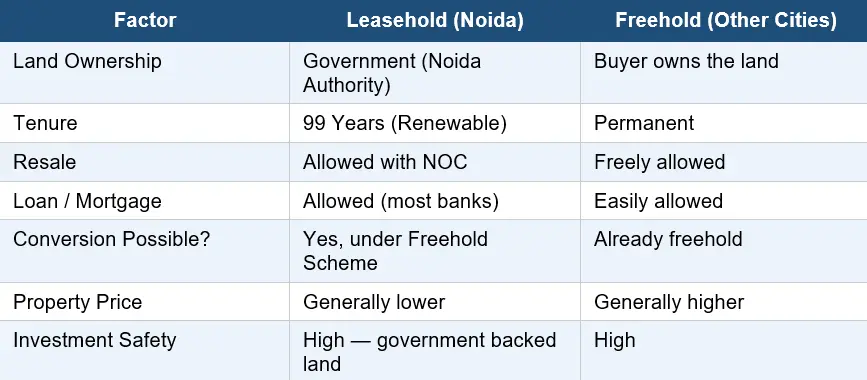
The key takeaway here is that leasehold does not mean unsafe. In Noida, leasehold is the norm — not the exception. Thousands of NRIs, investors, and homebuyers have purchased leasehold properties in Noida and have enjoyed full benefits of ownership, resale, and rental income without any issue. The Noida Authority’s backing actually makes these properties more regulated and secure compared to unregulated freehold land in smaller towns.
That said, if you are comparing buying in Noida versus a freehold property elsewhere and long-term land ownership matters to you, freehold has the edge. But within Noida, leasehold is the standard — and it comes with very strong legal protections.
Can You Convert Leasehold to Freehold in Noida — And What Does It Actually Cost?
In Noida, it is possible to convert your leasehold property to freehold. By paying a one-time conversion fee, current leaseholders can obtain full ownership of their land through the Noida Authority’s Freehold Conversion Scheme.
The property’s current circle rate and the remaining lease term are used to determine the conversion cost. Depending on the type of property (residential, commercial, or institutional), the fee usually varies from 10% to 25% of the property’s current market value or the value determined by the Noida Authority. It is best to check with the Noida Authority or a certified property consultant for the most recent rates, as the exact amount varies and is updated on a regular basis.
The step-by-step conversion process is as follows:
- Step 1 — Application: Submit a freehold conversion application to the Noida Authority along with original lease deed, ID proof, property documents, and applicable fee challan.
- Step 2 — Fee Payment & Verification: Pay the conversion fee (10%–25% of assessed value), after which the Noida Authority verifies all documents, clears any pending dues, and processes the request.
- Step 3 — Mutation & Registry: Once approved, a fresh freehold deed is issued and mutation is done in revenue records — your property is now permanently yours with full land ownership rights.
After conversion, you have permanent land ownership and your property becomes freehold, which makes it simpler to sell, mortgage, or transfer to heirs without any lease-related issues.
It’s crucial to remember that not every Noida property qualifies for freehold conversion. Properties that fall under specific restricted categories or have outstanding debts or disputes might not be eligible. Prior to applying, always confirm your eligibility.
Selling, Mortgaging & Getting a Loan on Leasehold Property — What Buyers Must Know
The ease with which buyers can sell leasehold property, obtain a home loan, or use it as collateral is one of the most frequent questions they have about it. In all three cases, the answer is yes, but under certain restrictions.
In Noida, selling a leasehold property is both common and entirely legal.However, you need a No Objection Certificate (NOC) from the Noida Authority before any sale transfer. This is a standard requirement and is processed through the Authority’s online portal. Most sales happen smoothly as long as the property has no outstanding dues or legal disputes. Properties with less than 30 years of lease remaining can sometimes face buyer hesitation, but this is practically not a concern for most Noida properties today, where leases still have 50 to 80+ years remaining.
Major banks and housing finance firms, such as SBI, HDFC, ICICI, and LIC Housing Finance, do provide home loans for leasehold properties in Noida. The standard requirement is that the lease term be at least 10 to 30 years longer than the loan term. Therefore, the bank will require at least 30 to 50 years of lease remaining if you are taking out a 20-year home loan. This is rarely an issue because the majority of Noida leases have 60 to 80+ years left on them. Loan approvals are essentially smooth for properties with 90 years or more left on their lease.
Banks accept leasehold properties in Noida as collateral for personal loans or loans secured by real estate, subject to their own evaluation. RERA-registered projects and properties with clear lease deeds from Noida Authority tend to get faster approvals.
Should You Avoid Leasehold Property? Red Flags, Smart Checks & the Real Truth
No — you should not avoid leasehold property in Noida just because it is leasehold. But you should know what to check before buying.
The real risks in leasehold property come not from the concept itself, but from poor documentation, pending dues, or unapproved construction. Here are the three most important checks every buyer must do:
- Verify Lease Deed & Remaining Tenure: Always check the original lease deed issued by Noida Authority and verify how many years remain on the lease. A property with 70+ years remaining is as good as permanent for practical purposes.
- Check for RERA Registration: All new projects in Noida must be RERA-registered under UP-RERA. A RERA number confirms the project is legally approved, construction is on schedule, and your money is protected. Never buy from an unregistered developer.
- Confirm No Pending Dues to Noida Authority: Many developers have outstanding lease rent or dues to Noida Authority, which can block your NOC at the time of resale or loan. Always get a dues clearance certificate before finalising any deal.
When you buy right — with proper documentation and from a RERA-approved project — leasehold property in Noida is one of the safest and most rewarding real estate investments in the NCR region.
How to Extend Your 99-Year Lease in Noida — Cost, Process & Timeline
The Noida Authority’s lease renewal policy governs the simple process of extending a lease in Noida. You must apply for the renewal, preferably well in advance of the expiration date, as it is not automatic.
At the time of renewal, the extension fee is usually computed as a percentage of the land’s current circle rate. Generally speaking, depending on the category and location, extension fees can vary from 5% to 15% of the property’s assessed value. The precise costs should be confirmed at the time of application because the Noida Authority updates these rates on a regular basis.
The process involves three key steps:
- Application Submission: Submit a lease renewal application to the Noida Authority with your original lease deed, identity documents, latest property tax receipts, and payment of the prescribed renewal fee.
- Authority Review & Approval: The Noida Authority reviews your documents, verifies there are no pending dues or legal disputes on the property, and then issues an approval letter for lease extension.
- Fresh Lease Deed Issuance: A new lease deed is executed extending the period — typically for another 30 to 99 years — which is then registered at the Sub-Registrar’s office to make it legally valid.
Depending on the authority’s workload and the completeness of the documentation, the processing time can vary from a few weeks to several months.
It is highly recommended that properties nearing lease expiration start the renewal process at least two to three years beforehand to prevent any legal issues or interruptions in real estate transactions during that time.
Top Localities in Noida Where Leasehold Properties Are a Smart Investment in 2025
Not every leasehold property is made equally. Your investment’s performance is determined by its location. The following Noida neighborhoods stand out in 2025 due to buyer demand, infrastructure development, and high returns:
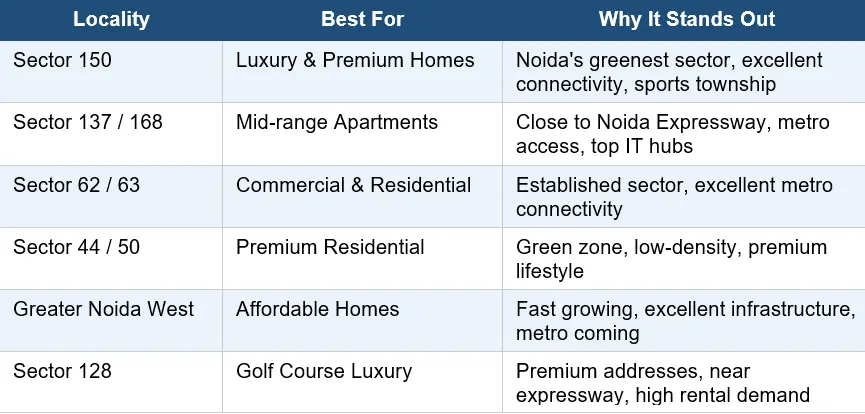
Whether you are a first-time homebuyer or an experienced investor, choosing the right sector makes all the difference. If you are unsure which locality suits your budget and goals, speaking with an expert can save you both time and money
RERA & Leasehold: How It Protects Noida Homebuyers From Developer Fraud
The Real Estate (Regulation and Development) Act, 2016 — commonly known as RERA — has been a game changer for leasehold property buyers in Noida. Before RERA, many buyers suffered delays, project abandonment, and hidden charges from developers. Today, UP-RERA has made the Noida real estate market significantly more transparent and buyer-friendly.
Under RERA, every new residential project in Noida must be registered with UP-RERA before any marketing or sale begins. The developer must disclose the full lease details, land title documents, project timeline, and escrow fund management. If a developer defaults, RERA gives buyers the right to claim compensation, demand refunds, or approach the RERA tribunal for resolution.
For leasehold properties specifically, RERA ensures that the developer has a valid lease from Noida Authority, the project is approved for construction, and all pending dues are disclosed upfront. This means when you buy a RERA-registered property in Noida, you are protected from the most common leasehold risks — fraudulent lease deeds, unapproved construction, and developer insolvency.
Always verify the RERA registration number of any project you are considering and cross-check it on the UP-RERA official portal before making any payment.
Your Next Step: How to Find Verified Leasehold & Freehold Properties in Noida
After reading everything above, you are now better equipped than most property buyers in India. But knowledge alone is not enough — finding the right property, verifying all documents, and negotiating the best deal requires the support of someone who knows the Noida market inside out.
At Housing in India, we make it easy to buy Noida property with complete confidence. Every listing on our platform is verified, RERA-approved, and comes with full transparency on lease details, developer credentials, and Noida Authority dues status. Whether you are looking for a budget-friendly apartment, a premium villa, or a commercial space — we have options across every price range and sector.
Our team of experts — recognised as the best Noida property consultant by thousands of satisfied homebuyers and investors — will guide you from your first search to your final site visit, completely free of charge. We offer real-time market insights, legal document verification, home loan assistance, and end-to-end support so you never feel lost in the process.
The 99-year lease is not something to fear — it is something to understand. And now that you do, the next step is simple.
Explore verified properties in Noida today at www.housinginindia.com and take your first step towards owning a home in one of India’s most dynamic real estate markets.